As an Amazon Associate I earn from qualifying purchases. Product links below are affiliate links. These are editorial suggestions, not claims of hands-on testing; choose only what solves your specific problem.
The short answer
There is no universal minimum connection time for older travelers. Add time for the airport layout, walking pace, assistance handoffs, security or customs, terminal changes, transport between concourses and the consequences of a missed connection.
How much connection time do older travelers need? Calculate the handoffs
There is no single number of minutes that works for every older traveler or every airport. A connection includes walking, finding the next gate, security or customs, an assistance handoff, a terminal transfer, restroom needs and the consequence of a missed flight. The right buffer is the time your actual route needs, plus enough margin that you are never forced to hurry.
Start with the airline's official minimum connection time, then test it against your real route. Domestic-to-domestic, international-to-domestic and two separate tickets carry very different risks. Assistance, large airports and checked bags each add a handoff that a booking screen will not show you.
- The airline's minimum connection time is a legal minimum, not a comfortable one.
- Terminal changes, passport control and bag re-checks each add substantially to it.
- If you use assistance, the handoff between teams is where the time goes.
- A longer connection usually costs less than the flight you would miss.
What actually eats a connection
Connection time is not one thing; it is four or five separate obstacles in a row. Adding them up honestly for your own airports gives a far more useful number than any general rule.
| Factor | Question | Add to the decision |
|---|---|---|
| Airport | How far are the gates and terminals? | Map, train, bus and walking time |
| Border/security | Will immigration, customs or re-screening occur? | Follow-on queue and bag process |
| Mobility | Is assistance requested or walking limited? | Handoff and wait time |
| Ticket | One booking or separate tickets? | Rebooking protection and baggage |
| Consequence | What happens if the connection is missed? | Choose a calmer itinerary when risk is high |
Read the airport map before you trust the schedule
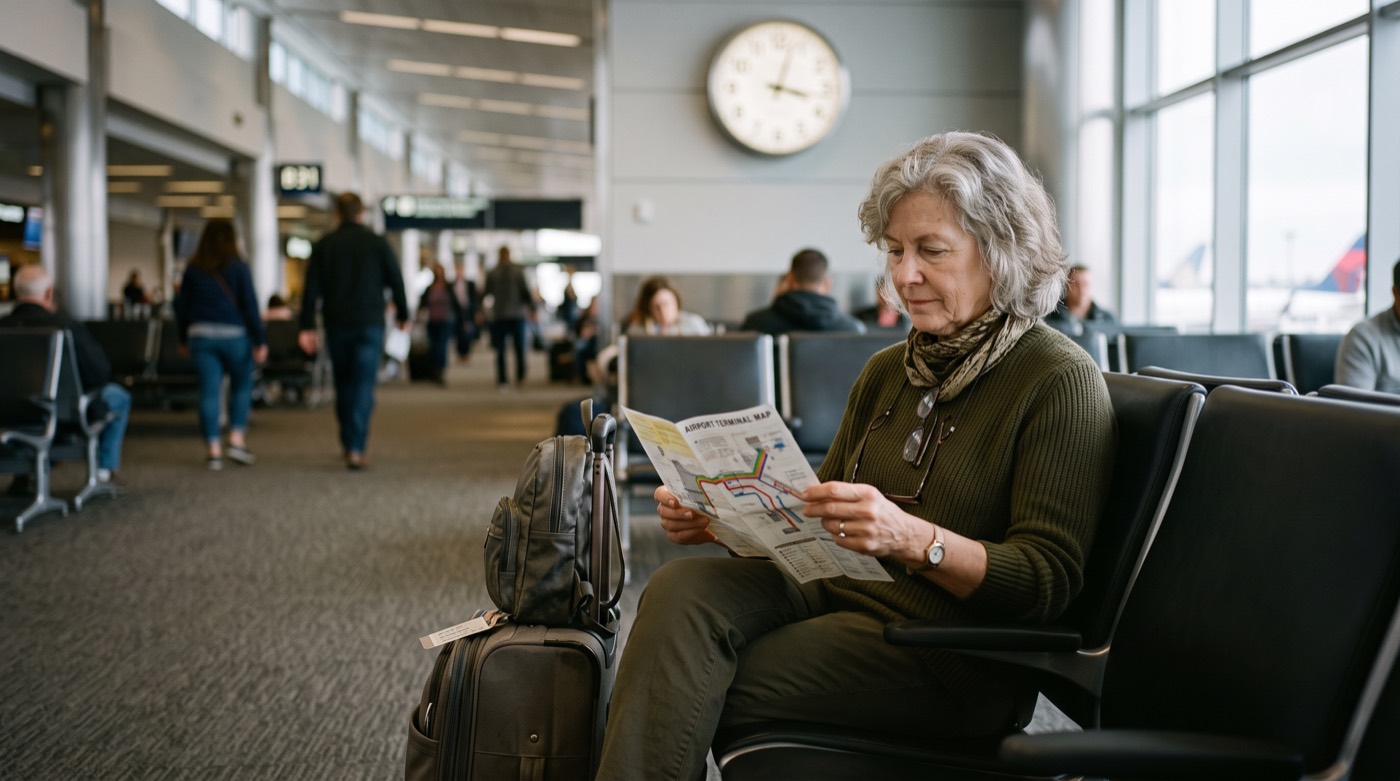
Open the airport map and note the sequence: arrival gate, restroom, assistance desk, security, terminal transport and departure gate. If you use assistance, confirm whether it transfers automatically between teams or has to be requested again. A connection that looks short on paper can be perfectly reasonable at one airport and impossible at another.
A longer connection is not wasted time. It buys rest, a meal, a restroom without hurry, and a much lower chance of missing the segment that mattered most on the whole trip.
- Use the airport’s own connection guidance where available.
- Treat customs, security and terminal transport as separate steps.
- Allow for restroom, medication, food and rest.
- Avoid separate-ticket connections when the consequence is unacceptable.
Adding up a realistic connection
The published minimum assumes an able, unencumbered passenger, an on-time arrival and adjacent gates. Change any one of those and the number stops being realistic.
Work down this table for your own connection. If the total comes to more than the time you have, that is not pessimism — it is the actual answer, and it is worth paying to change the booking.
| What has to happen | Typical time | When it takes longer |
|---|---|---|
| Getting off the aircraft | 10–20 minutes | Rear seats, or waiting for assistance |
| Walking to the next gate | 10–25 minutes | Different terminal, or a slower walking pace |
| Changing terminals | 15–30 minutes | Shuttle trains and buses run to their own schedule |
| Passport control (international) | 20–60 minutes | Peak arrival banks, several flights landing together |
| Re-checking a bag | 15–30 minutes | Separate tickets, or a change of airline |
| Security again | 10–30 minutes | Any international-to-domestic connection |
How to check a connection before you book it
Here is how to check a specific connection before you commit to it.
- Identify domestic/international segments and operating carriers.
- Map gates, terminals, security, customs and transport.
- Add assistance handoff and walking pace.
- Check baggage and rebooking protection.
- Choose a buffer that leaves time to sit and recover.
- Save a backup plan for delay, gate change or missed connection.
When the connection fails anyway
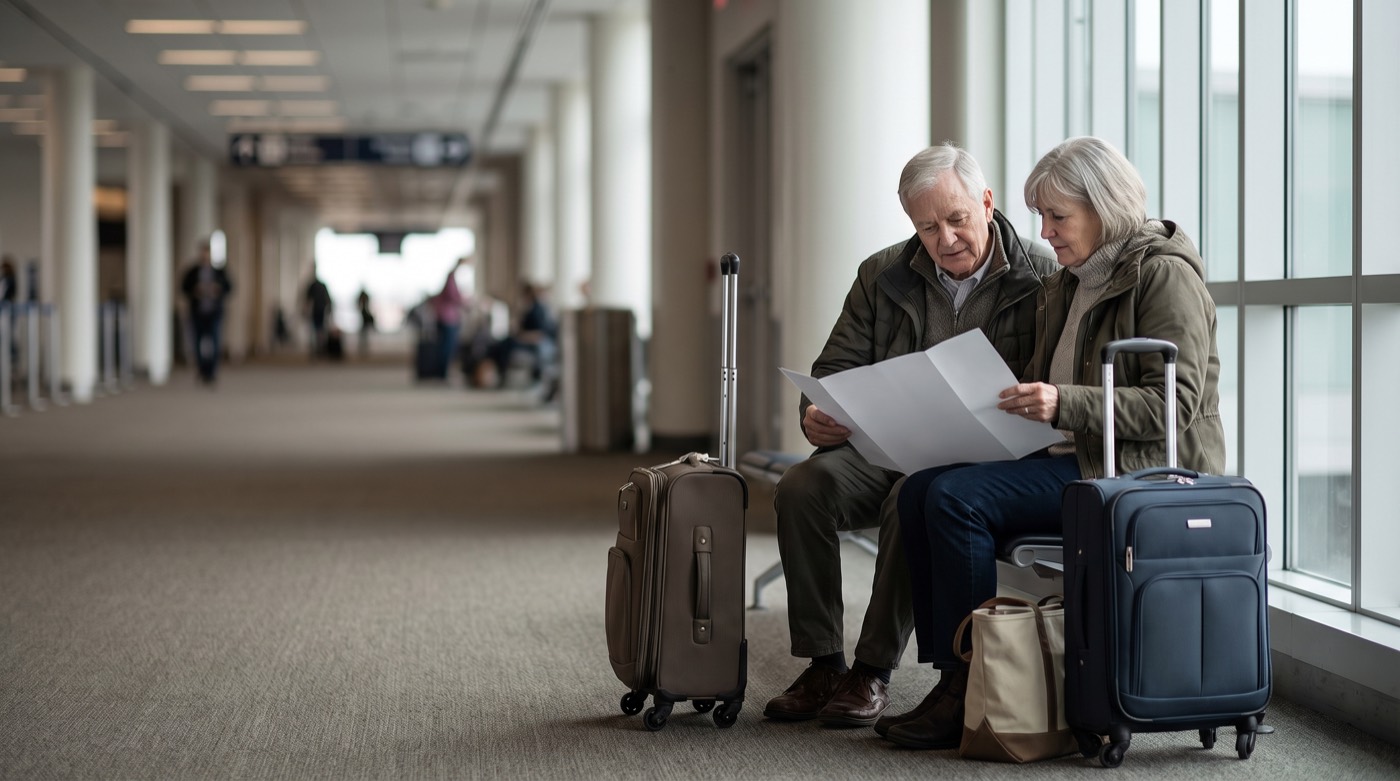
Sometimes a good plan meets a delayed inbound flight. On a single ticket the airline is responsible for getting you to your destination, and the practical priority is to be rebooked quickly rather than to be first in the queue for an explanation.
Two tickets bought separately are a different situation entirely: nobody is responsible for the connection but you. That is the strongest single argument for booking a through fare rather than saving a little on two separate flights.
- Prefer one ticket for the whole journey over two cheaper separate ones.
- Ask the crew to be let off early only if it is genuinely tight — and ask before landing.
- Know your airline's app; rebooking there is often faster than the desk.
- Keep essentials in your cabin bag, in case an overnight is forced on you.
Questions people ask
How much connection time is enough for an older traveler?
There is no universal number. Calculate airport walking, assistance, security/customs, terminal transport, baggage and the cost of a missed connection.
Does assistance change connection time?
Yes. Include the request, wait and handoff process and confirm it with the airline.
Are separate tickets risky?
They can be, because the second carrier may not protect the itinerary or baggage after a delay; compare the consequence honestly.
How should I choose between short and long connections?
Prefer the itinerary whose buffer lets you walk, rest and recover without rushing — especially when missing that connection would cost you a whole day or a paid booking at the other end.
Sources & how we keep this current
Rules, fees and programs change. These are the official pages we check — go to them for the version that applies on your travel date.
Last reviewed: September 7, 2026. Confirm the linked official guidance for your own travel date.