
As an Amazon Associate I earn from qualifying purchases. Product links below are affiliate links. These are editorial suggestions, not claims of hands-on testing; choose only what solves your specific problem.
The short answer
The best carry-on for travelers over 60 is light enough to lift, stable to roll, easy to open and sized for the airline you are actually flying. Prioritize handling and access over a long feature list, and check the carrier’s current size and weight rules before departure.
Carry-on luggage for travelers over 60: handling beats feature count
A carry-on can look perfect on a product page and still be miserable at a real airport. A heavy case has to be lifted into a car, pulled over uneven pavement, turned in a narrow hotel corridor and opened while you are tired. For older travelers, the useful question is not which suitcase has the longest feature list. It is whether the bag can be handled confidently on the actual itinerary.
Start from the trip you actually take. A short domestic hop, a long international route, one-bag travel and a checked bag plus a personal item all reward different cases. Weight, wheel stability, handle height, ease of access and zipper effort are what you will notice on the day — far more than any feature printed on the box.
- Start with the heaviest thing you will actually lift: the packed bag into an overhead bin.
- A case that rolls beautifully on a showroom floor may fight you on airport tile and outdoor pavement.
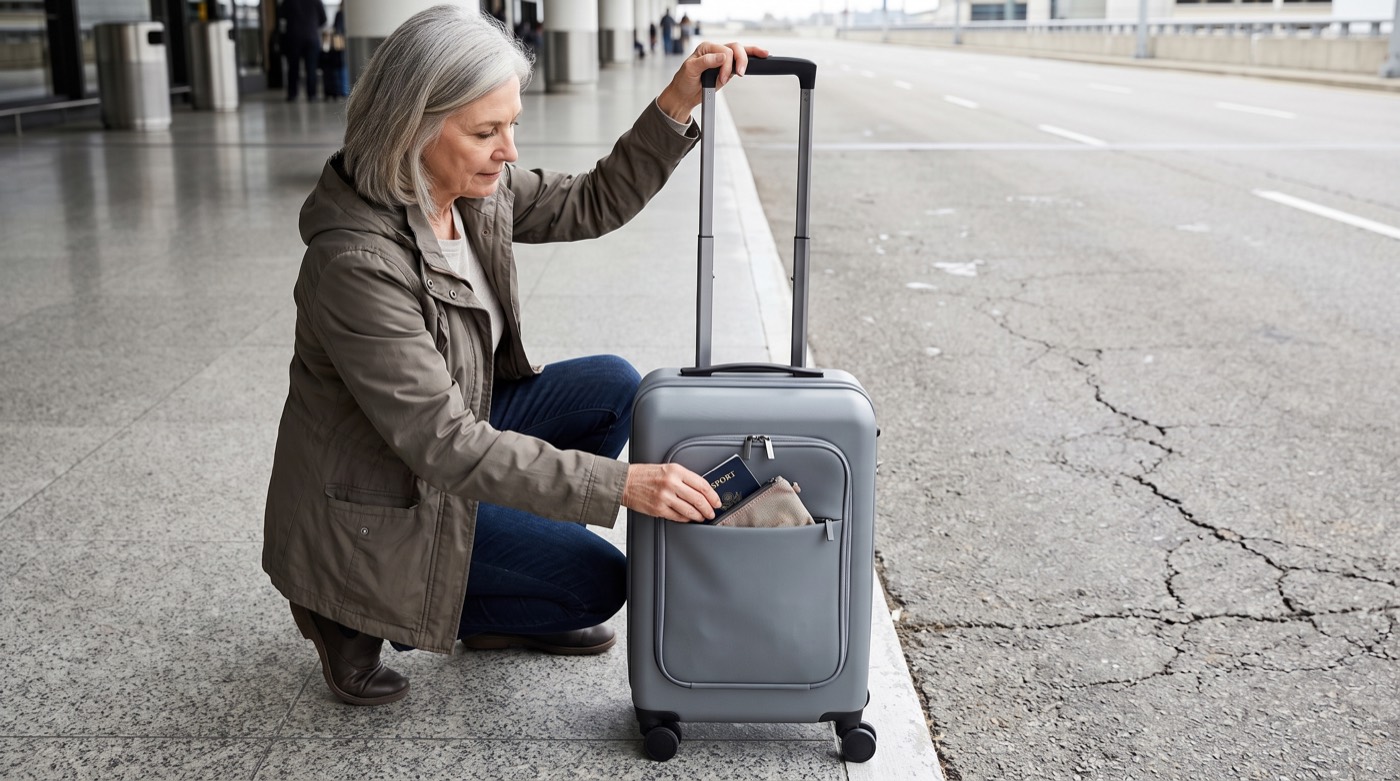
- Front access matters most if medication or documents must come out quickly.
- The airline's sizer, not the label on the bag, decides whether it goes in the cabin.
The four things worth comparing
Ignore the feature lists for a moment. Four variables decide whether a carry-on suits you, and every one of them is something you can test before you buy. Use this as a checklist in the store or against the specification page online.
| Weight | Can you lift the packed bag into a car or overhead bin? | Empty weight matters because every feature reduces usable packing weight |
|---|---|---|
| Wheels/handle | Does it roll straight and turn without force? | Test on rough pavement and with one hand |
| Access | Can you reach medication, documents or a layer quickly? | Front access helps, but adds weight and failure points |
| Size | Does the packed case fit the carrier’s current limit? | Measure the outside, including wheels and handles |
The carry-on test that matters at the airport
Pack the bag with the items you really carry: medication, electronics, a layer, documents and shoes. Then lift it from the floor, roll it around a corner and open it without blocking a walkway. A suitcase that is technically light but hard to control may be the wrong choice.
Check the airline before you buy, not after. Carry-on dimensions and weight limits vary by carrier and by fare, and a case sold as “cabin size” is a manufacturer's claim rather than a guarantee for your ticket.
- Hard shell or soft side based on access and protection needs.
- Two wheels can handle rough ground differently from four spinner wheels.
- A stable handle and comfortable grip matter on long walks.
- Medication and a spare layer should not be buried under everything else.
Walk through one real travel day with the bag
A suitcase is not used in a shop. It is used at 5 a.m. in a driveway, at a security belt, on a jet bridge and in a hotel corridor at midnight. Before you buy, picture your next actual trip and ask what the bag has to do at each of those moments.
The table below is that walk-through. If a case struggles at any single row, it is the wrong case for you — no matter how good it looks or how well it reviews for someone else.
| Moment of the trip | What the bag has to do | What to test before buying |
|---|---|---|
| Leaving home | Get from the hall into a car trunk | Lift it packed, once, with one hand |
| Airport curb to gate | Roll straight over tile, carpet and thresholds | Push it one-handed around a tight corner |
| At security | Open flat and close again quickly | Unzip and re-zip it while it is full |
| Boarding | Go up into the overhead bin | Lift it to shoulder height and hold for five seconds |
| Hotel room | Open in a small space without tipping | Stand it upright and open the lid halfway |
Buying a carry-on, in the right order
You now know what to look for. This is the order that saves the most wasted effort — the airline check comes first, because it can rule out a case before you compare anything else.
- Write down the airline, fare and route before comparing cases.
- Measure the bag’s outside dimensions, including wheels and handles.
- Check empty weight and estimate the packed weight.
- Test lift, roll, turn, handle height and zipper effort.
- Read warranty, repair and return terms.
- Recheck the carrier’s allowance before departure.
What to expect from a good carry-on — and what not to
A good carry-on will not make an airport shorter. What it will do is remove the small failures that add up: the bag that tips over, the zip that needs both hands, the case you cannot lift alone. That is a real improvement, and it is worth paying for once.
What it cannot do is override an airline's rules. A bag sold as cabin-size is a manufacturer's claim, not a guarantee, and allowances change. Keep the receipt and the return window in mind until you have flown with it once.
- Buy for the trips you actually take, not the longest one you might take.
- Prefer a lighter case with fewer features over a heavier one with more.
- Check the warranty covers wheels and handles — those are what fail.
- Test it fully packed within the return period, not the week before you fly.
Questions people ask
What makes carry-on luggage suitable for travelers over 60?
Low empty weight, stable rolling, a comfortable handle, easy access and dimensions that fit the actual airline rule.
Is four-wheel luggage always best?
No. Spinner wheels and two-wheel cases behave differently on smooth floors and rough pavement; test the handling you will actually need.
How do I check carry-on size?
Measure the packed bag including wheels and handles and compare it with the current allowance for your fare and operating carrier.
What should I keep accessible?
Medication, documents, glasses, a layer and devices should not be buried below items you may need during the journey.
Sources & how we keep this current
Rules, fees and programs change. These are the official pages we check — go to them for the version that applies on your travel date.
Last reviewed: September 7, 2026. Confirm the linked official guidance for your own travel date.